Woman pouring milk in a domestic interior, warm light from a window illuminating a white ceramic jug and earthenware bowl on a wooden table

Johannes Vermeer · c. 1657–1658

The Milkmaid (detail)

"Light from upper left — always ask: why that window?"

Quick Read · Before You Begin

Northern Baroque or Dutch Golden Age —
and why does the answer change everything?

Look at the painting. Trust your instinct. Choose one — then we'll show you why the question itself is the lesson.

Student avatar 1Student avatar 2Student avatar 3

2,400+ students used this guide last finals season

Composition · Palette · Symbolism · Context · Argument · Composition · Palette · Symbolism · Context · Argument · Composition · Palette · Symbolism · Context · Argument · Composition · Palette · Symbolism · Context · Argument · Composition · Palette · Symbolism · Context · Argument · Composition · Palette · Symbolism · Context · Argument · Composition · Palette · Symbolism · Context · Argument · Composition · Palette · Symbolism · Context · Argument ·
The Method

How to read a painting in five passes

We'll work through the same painting at each step — Vermeer's Milkmaid — so you can watch the analysis deepen. By the fifth pass, you'll have an essay argument you didn't have at the first.

Scroll to begin
01

Composition

Where does the eye go — and who decided that?

Woman pouring milk, warm window light casting shadows across white ceramic jug and earthenware bowl

The triangular composition (figure → table → window) creates a closed visual circuit — your eye cannot escape the scene.

The first pass is purely spatial. Ignore subject matter entirely. You're tracing vectors — the diagonal of the jug's pour, the perpendicular of the table edge, the triangular mass of the figure's torso. Vermeer builds a geometry of stability. Everything anchors.

Notice the window: upper left, raking light, the oldest compositional trick in northern painting. Light enters at an angle that creates maximum shadow-to-highlight contrast across a single face or object. This is not accident — it is argument. Vermeer is saying: *here is what matters*.

Quick Check

In "The Milkmaid," where does the primary light source originate?

02

Palette

What do the colors say before the subject speaks?

Close-up of rich blue ceramic glaze beside warm ochre bread rolls on a wooden table

Ultramarine blue in 1657 cost more per ounce than gold. Its presence here is a deliberate signal of household wealth.

Vermeer's palette here is almost brutally restrained: ultramarine blue (expensive, imported from Afghanistan via Dutch trade routes), lead white, ochre, and a raw umber for the shadows. The blue apron is not decorative. It was a status signal — only a well-provisioned household could afford ultramarine on a servant's clothing.

The warm ochres of the bread and the cool blue of the apron create a thermal tension that makes the scene hum. This is palette as argument: warmth (nourishment, domestic labor, the body) against cool (order, economy, the Protestant merchant's world).

Quick Check

What does the expensive ultramarine blue in the apron most likely signal to a 17th-century Dutch viewer?

03

Symbolism

What objects are doing double duty?

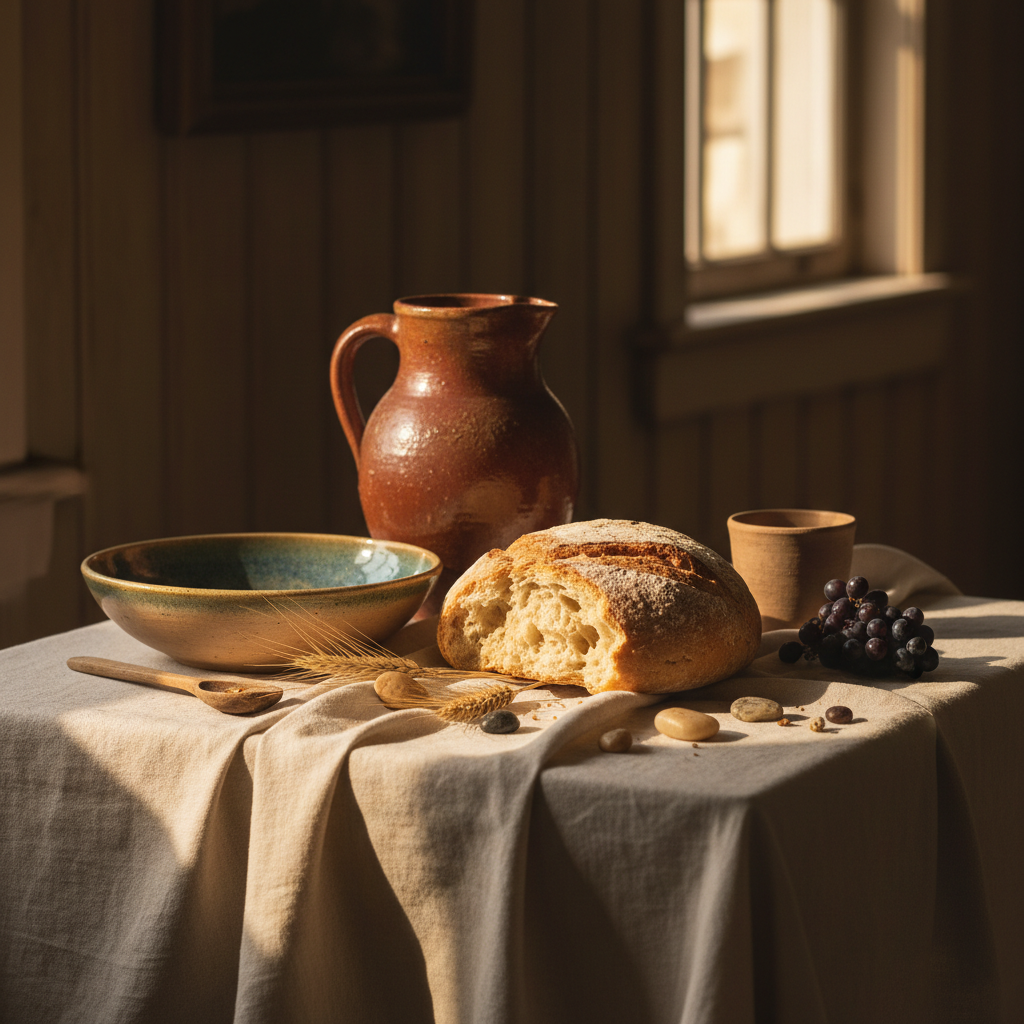
Still life detail showing ceramic vessels, bread loaf, and scattered objects on a draped table in warm light

The broken window pane at upper left is often read as a reference to vulnerability — the household is real, not ideal.

In 17th-century Dutch painting, almost nothing is merely decorative. The bread on the table — dense, round, substantial — is eucharistic. The milk being poured is both literal sustenance and a coded reference to *caritas*, Christian charity. The foot warmer in the lower corner, partially visible, is a standard emblem of female sexuality and domestic virtue simultaneously.

Vermeer's genius is that the symbolism never overwhelms the realism. You can read this painting as pure observation — a woman pouring milk — or as a densely coded moral argument about labor, nourishment, and the Protestant household. Both readings are correct. This is what makes it inexhaustible.

Quick Check

What does the act of pouring milk most likely symbolize in Dutch Golden Age iconography?

04

Context

What was happening outside the frame?

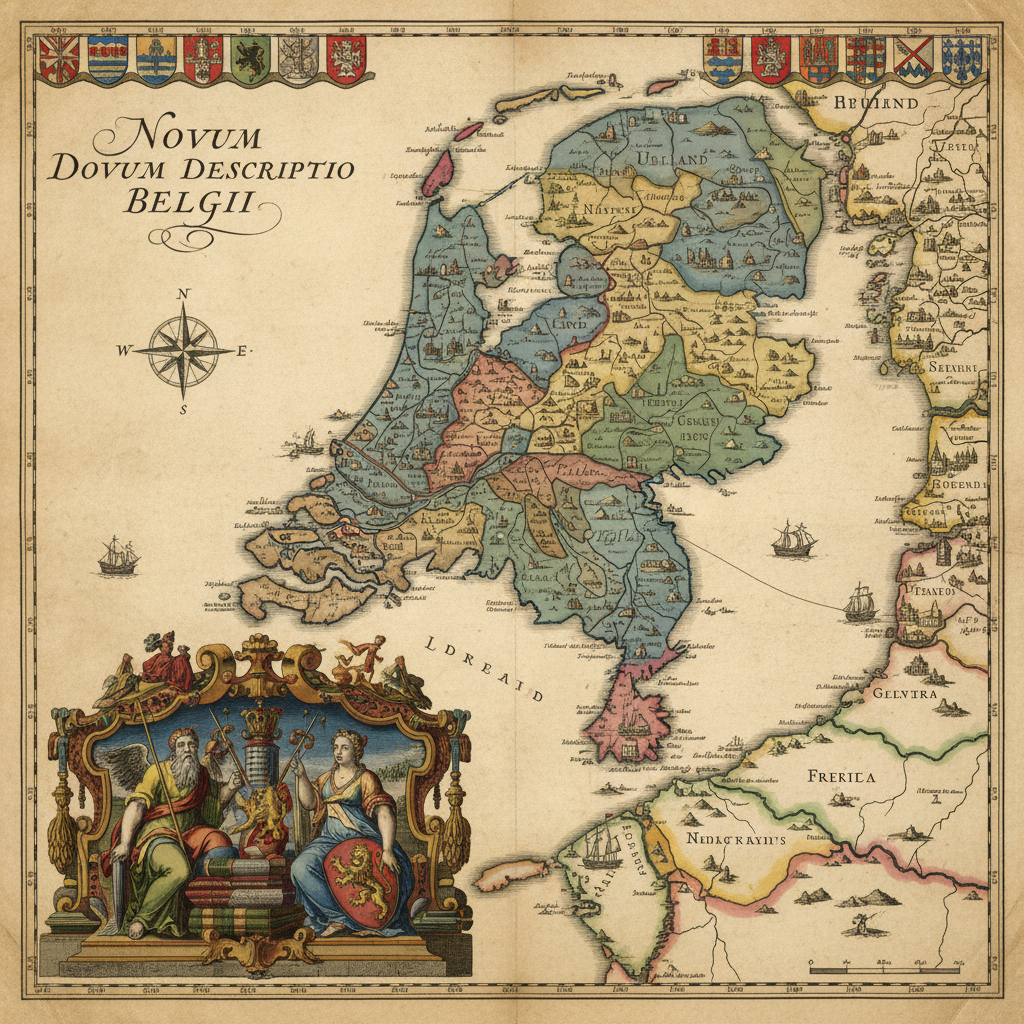
Antique map of the Netherlands with period cartouche and hand-colored regions showing Dutch Golden Age geography

Delft in 1657 had a population of roughly 24,000. Vermeer knew perhaps 200 people. His subjects were neighbors.

The painting was made in Delft, 1657–58, during the height of Dutch Republic prosperity. The Peace of Westphalia (1648) had ended eighty years of war with Spain. Amsterdam was the world's financial capital. Protestant merchants were commissioning domestic scenes — not religious altarpieces — because the Calvinist church banned devotional images. The genre of domestic interior *is* the religious painting of Protestant Holland.

Vermeer himself was Catholic, living in a Protestant city, painting Protestant interiors. His position as an outsider may explain the quality of his observation — he was always watching, never quite inside the world he painted. Context doesn't explain a painting, but it changes what you see in it.

Quick Check

Why did Dutch Calvinist patrons commission domestic interiors rather than religious paintings?

05

Argument

What is the painting actually claiming?

Abstract canvas with warm earth tones and gestural brushwork suggesting domestic interior space in evening light

Your essay argument: Vermeer uses restricted palette, domestic symbolism, and Protestant iconography to elevate labor as moral subject.

Now synthesize. The Milkmaid is not a neutral observation. It is an argument: that domestic labor is dignified, that the Protestant household is a site of moral order, that the material world — bread, milk, earthenware, light — is sufficient subject matter for serious art. This was a radical claim in 1657. Italian painting had spent two centuries insisting that only history, mythology, and religion were worthy subjects.

Vermeer's argument won. The domestic interior became the foundational genre of modern painting. When Cézanne painted apples, when Hopper painted diners, when Morandi painted bottles — they were all working inside a tradition that Vermeer and his contemporaries built. The Milkmaid is not just a beautiful painting. It is a position statement that changed the course of Western art.

Quick Check

What was the lasting art-historical significance of the Dutch domestic interior genre?

You just did that.

You've read a painting more carefully than most students do in an entire semester.

The Study Library applies this exact method across 340 guides — Renaissance, Modernism, Photography, Architecture, and beyond. Each one is written like this: no jargon, no gatekeeping, just the analysis that makes the work open up.

Open the Study Library →
The Study Library

340 guides. One method.

Every guide applies the five-pass method to a different movement, artwork, or question. Browse by period, difficulty, or theme. No account required for the first guide in each collection.

Open Full Library
Renaissance · Renaissance · Baroque · Baroque · Romanticism · Romanticism · Realism · Realism · Impressionism · Impressionism · Post-Impressionism · Post-Impressionism · Modernism · Modernism · Surrealism · Surrealism · Abstract Expressionism · Abstract Expressionism · Minimalism · Minimalism · Conceptual Art · Conceptual Art · Photography · Photography · Architecture · Architecture · Sculpture · Sculpture · Printmaking · Printmaking ·
Fresco ceiling painting with figures in classical poses, warm ochre and blue tones against architectural setting
1400–1600Survey Level

Italian Renaissance

From Masaccio's groundbreaking perspective to Michelangelo's Sistine ceiling — the complete arc of humanism in paint and stone.

PerspectiveHumanismFlorence
68 guides
Loose brushwork painting in blue and violet tones suggesting a garden scene with dappled light
1860–1900Introductory

French Impressionism

Why Monet painted haystacks fourteen times. What Degas actually thought about dance. How color became argument.

Color theoryPlein airSalon des Refusés
54 guides
Large canvas with gestural marks in deep crimson and black, raw canvas showing at edges
1940–1965Advanced

Abstract Expressionism

Rothko's color fields, Pollock's drips, de Kooning's figures. Why standing in front of the canvas is the only way to understand it.

New York SchoolGestureScale
41 guides
Black and white photograph showing dramatic shadow and light pattern across architectural columns
1839–presentIntroductory

Photography as Fine Art

From Talbot's calotypes to Cindy Sherman's self-portraits — how photography argued its way into the museum.

PictorialismDocumentaryConceptual
37 guides
Dramatic interior scene with single light source illuminating a figure against dark background in Baroque style
1600–1680Survey Level

Northern Baroque

Rembrandt's light, Caravaggio's violence, Vermeer's stillness. The full arc of a century that made darkness speak.

ChiaroscuroTenebrismDutch Republic
49 guides
Clean geometric building facade with repeating rectangular windows and minimal ornamentation in concrete and glass
1900–1970Advanced

Modernist Architecture

Less is more — and why Le Corbusier, Mies van der Rohe, and Wright each meant something different by it.

BauhausInternational StyleFunctionalism
29 guides
Take It With You

Download this guide
as a beautifully typeset PDF.

The complete five-pass walkthrough — with all five micro-quizzes, the Vermeer analysis, and a blank template for applying the method to any painting — formatted for print or a tablet beside your textbook.

  • Five-pass method with full Vermeer analysis
  • Blank template for any painting you study
  • Glossary of 40 essential art history terms
  • Essay structure guide for formal analysis

"What's your first name? We'll address the PDF to you."

No spam. One email with your PDF, and occasional new guides if you'd like them.